BrentDaug
In the annals of American UFO history, few incidents have inspired as much fascination—and speculation—as the one in Roswell, New Mexico.
It began in the summer of 1947, at the dawn of the Cold War, when the U.S. Army Air Forces sent out a shocker of a press release, announcing they’d recovered a “flying disc” from a ranch near Roswell. More than 70 years later, the incident remains a defining aspect of the area’s identity: The town boasts a UFO museum and research center, a flying saucer-inspired McDonald’s, alien-themed streetlights, even an extraterrestrial “family” stranded in a broken-down UFO on the side of State Route 285, looking for a jump-start.
But behind all the UFO mania lies an uneasy truth. The events that transpired that summer are anything but clear-cut, with admitted coverups and conflicting explanations: It was a saucer! It was a spy craft! It was the Soviets!
And new ones are still emerging.
Here are the agreed-upon facts about the Roswell crash.
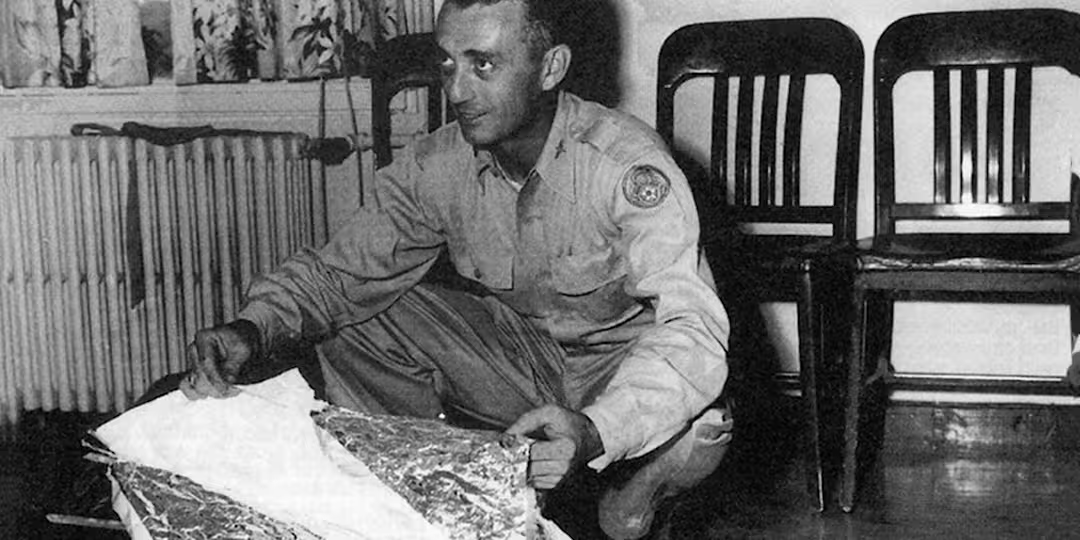
Sometime between mid-June and early July 1947, rancher W.W. “Mac” Brazel found the wreckage on his sizable property in Lincoln County, New Mexico, approximately 75 miles north of Roswell. Several “flying disc” and “flying saucer” stories had already appeared in the national press that summer, leading Brazel to believe the wreckage—which included rubber strips, tinfoil, and thick paper—might be something of that ilk. He brought some of the material to Sheriff George Wilcox of Roswell, who in turn brought it to the attention of Colonel William Blanchard, the commanding officer of the Roswell Army Air Field (RAAF).
The next day, the RAAF released a statement, writing that, “The many rumors regarding the flying disc became a reality yesterday when the intelligence office of the 509th Bomb Group of the Eighth Air Force, Roswell Army Air Field, was fortunate enough to gain possession of a disc through the cooperation of one of the local ranchers and the sheriff’s office of Chaves County.”
According to that statement, Major Jesse Marcel, an intelligence officer, oversaw the RAAF’s investigation of the crash site and the recovered materials.
The government changed its story about the Roswell ‘saucer’—a few times.
Other elements of the Roswell story—namely that some eyewitnesses claimed that there were alien bodies taken from the site—were explained as fallen parachute-test dummies in a more extensive follow-up report in 1997.
Roger Launius, a historian and retired curator for the Division of Space History at the Smithsonian National Air and Space Museum, says those two reports close most of the remaining questions about Roswell.
“This story has been resolved,” Launius says. “Has absolutely every question been answered? I can’t say that. But I’m not sure that there are significant holes.”
“You do not divulge state secrets in the context of national security… My surmise is they probably saw [the initial flying saucer explanation] as a useful cover story.”
Donald Schmitt, a UFO researcher who has spent nearly three decades investigating the Roswell incident and is the co-founder of the International UFO Museum and Research Center in Roswell, says that explanation makes little sense. The “flying saucer” story, he contends, was so ostentatious that it was bound to draw attention to the area, with its sensitive military operations at the time. Doing so would seem highly counter to the interests of the War Department.
“Two hours west of Roswell the first atomic bomb was detonated. You had ongoing atomic research at Los Alamos. You had all this testing of captured German V-2 rockets at White Sands. And at Roswell, you had the first atomic bomb squadron headquartered,” Schmitt says. “The thought that they would have intentionally set up any type of publicity as a distraction? If anything, they needed less attention.”
Was Roswell’s ‘UFO’ from the USSR?
That theory could go some way in explaining the wreckage described by Jesse Marcel, Jr., the son of the intelligence officer named in the initial press report. According to Marcel, Jr.’s book, The Roswell Legacy, his father brought some of the UFO wreckage home, allowing his son to handle the debated debris before he took it to his base.
Marcel Jr. wrote that the material was metallic and “I could see what looked like writing. At first, I thought of Egyptian hieroglyphics, but there were no animal outlines or figures. They weren’t mathematical figures either; they were more like geometric symbols—squares, circles, triangles, pyramids, and the like.”
Marcel Jr. was 11 years old at the time, and the Cold War only just beginning. Could the young boy have been reading the Cyrillic alphabet for the first time, allowing his imagination to do the rest?
On this, Schmitt and Launius agree: It’s not likely.
“There’s no evidence in any Soviet archives that there were such experiments as this,” says Launius. “And if the intent was to generate panic, it failed utterly miserably.”
*/ Credits: Image(s) courtesy of Getty Images; Article courtesy of History.com





Have any thoughts?
Share your reaction or leave a quick response — we’d love to hear what you think!
-
 1
1 - 0
- 0
- 0
- 0
- 0