 BrentDaug
 BrentDaug
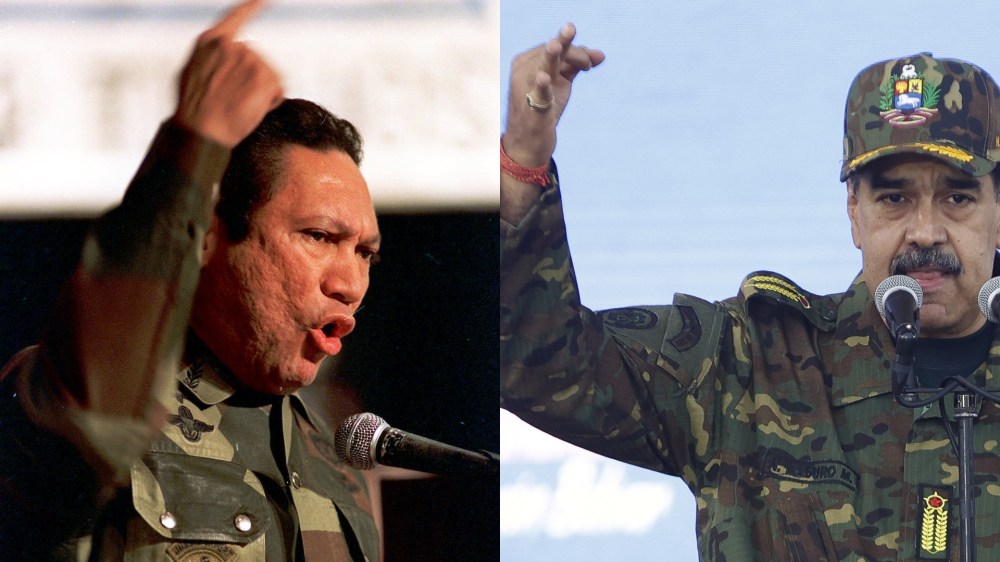
When the United States took Venezuelan President Nicolás Maduro from his home on Saturday, it was 36 years to the day since U.S. forces captured another South American strongman: Panama’s Manuel Noriega.
Their cases are both extraordinary and similar: both were indicted on drug-trafficking charges by federal grand juries in the U.S.; both were taken by U.S. forces from their home turf; and both claimed their arrests were illegal.
For Noriega, that argument failed. His trial, which ended in a conviction and a 40-year prison sentence, could foretell Maduro’s fate in the current case.
“The legal framework established in Noriega’s case will directly govern Mr. Maduro’s prosecution,” Nicholas Creel, a law professor at Georgia College & State University, wrote for The Wall Street Journal. “Too bad for him that the arguments we can expect his lawyers to make have already been litigated, and rejected, by federal courts.”
Clark Neily, senior vice president for criminal justice at the Cato Institute, a libertarian think tank, told Straight Arrow News that questions about the legality of seizing a foreign leader to stand trial in the U.S. were settled by the Noriega case.
“Two things are true,” Neily said. “First, there are differences between the Noriega operation and what we saw last weekend with Maduro. As far as U.S. courts are concerned, I expect the similarities to be more relevant. The similarities are that in both cases, military force was used to obtain physical custody of a foreign leader who was under indictment in the U.S. for drug crimes.”
The case against Noriega
In 1988, federal grand juries in Miami and Tampa, Florida, indicted Noriega on charges that included racketeering, drug smuggling and money laundering. Negotiations to persuade Noriega to resign his position in Panama and face trial in the United States failed.
Then-President Ronald Reagan balked at invading Panama to capture Noriega. But after his successor, George H.W. Bush was elected, there was a huge shift.
Under Bush, U.S. forces invaded Panama and surrounded Noriega’s place of hiding. U.S. troops notoriously blasted rock music at an unbearable level until Noriega surrendered.
Noriega was taken to Miami to stand trial.
Noriega’s defense attorneys argued multiple points, the strongest perhaps being that he enjoyed immunity from prosecution as a head of state immunity and that the U.S. unlawfully took him into custody.
“Noriega raised defenses, such as head of state immunity and the forceful capture and rendition to the U.S.,” Neily told SAN. “All of those were rejected.”
The government relied on a memo written by William Barr, a future U.S. attorney general who then was an official in the Justice Department’s Office of Special Counsel. He said a president had “inherent legal authority” to order the capture of a foreign leader accused of a crime in the United States, even if it violated international law.
The courts ultimately found that any immunity that foreign leaders might enjoy did not protect them if they engaged in criminal activity.
“They noted that the immunity exists to facilitate diplomatic relations and protect official state functions, not to shield drug traffickers,” Creel wrote. “Noriega’s drug trafficking was seen as clearly private criminal conduct, not an official governmental act.”
Noriega was convicted and sentenced to 40 years in prison. He ultimately served almost three decades in the U.S., France and Panama, where he died of a brain tumor in 2017 at age 83.
The case against Maduro
While Noriega was captured and taken to Miami for trial, Maduro was taken to New York City, where he was indicted on drug-trafficking charges in 2020. In his first appearance in court this week, he claimed he was a prisoner of war and was “kidnapped” by U.S. forces.
Some experts say that Maduro may have a stronger argument than Noriega about immunity from prosecution. While Noriega sat as the de facto head of state for six years, he was never officially recognized as the country’s president.
Maduro was elected president of Venezuela in 2013, following the death of his predecessor, Hugo Chavez. Most international observers believe Maduro’s most recent election, in 2024, was the result of fraud.
Some, including retired prosecutor Dick Gregorie, who indicted Noriega, said that even if Maduro uses a similar defense, it likely will not matter because the U.S. does not recognize Maduro as Venezuela’s legitimately elected head of state.
“There’s no claim to sovereign immunity if we don’t recognize him as head of state,” Gregorie said. “Several U.S. administrations, both Republican and Democrat, have called his election fraudulent and withheld U.S. recognition. Sadly, for Maduro, it means he’s stuck with it.”
The legality of Trump’s order to seize Maduro is not likely to matter, legal experts say, even though he failed to notify Congress or the United Nations Security Council before the military action.
”The use of the military to conduct an operation in a foreign country is sufficiently towards the warmaking end of the spectrum,” Neily said. “It’s the constitutional, assigned role of Congress to declare war, and not the president.”
However, Neily added that the military action exists in legally disputed territory.
“There’s a lot of grey area, because the president is commander-in-chief of the military,” he said. “Historically, that’s been understood to, at least, authorize some power to the president to act unilaterally using military force.”
In Maduro’s case, as in Noriega’s, Neily said, “military force was used to obtain physical custody of a foreign leader who was under indictment in the U.S. for drug crimes.”
Ultimately, Maduro’s fate will rest in how a jury considers the facts of the case.
“It boils down to a black and white question,” Neily said. “Was he or was he not a major player in a transnational drug distribution scheme that involved a number of drug cartels in Colombia, Mexico and elsewhere?”
If a jury decides he was, Maduro could, like Noriega, spend the rest of his life in prison.
Content retrieved from: https://san.com/cc/the-us-brought-a-south-american-strongman-to-trial-3-decades-ago-his-case-could-foretell-maduros-fate/.
 Author's Comment





Have any thoughts?
Share your reaction or leave a quick response — we’d love to hear what you think!
-
 0
0 - 0
- 0
- 0
- 0
- 0