
Few chapters of the Bible spark as much fear, fascination and debate as Revelation 13. It introduces two terrifying beasts, a mysterious number, and a mark without which no one can buy or sell. Over the centuries, people have used it to name everyone from Roman emperors to popes to modern world leaders, and almost every generation has been sure the end was near.
So what does Revelation 13 actually say? What did it mean to the first readers? And how should a believer read it today without falling into fear or fanaticism? Let's walk through the chapter carefully.
The Setting: Why Was Revelation Written?
The apostle John wrote Revelation from the island of Patmos, exiled "on account of the word of God and the testimony of Jesus" (Revelation 1:9). The seven churches he addressed in Asia Minor were facing pressure to compromise, including the cult of the emperor, economic hardship for those who would not conform, and in some cases persecution and death.
Revelation is apocalyptic literature, a genre full of symbols, numbers and visions. Its purpose is not to give us a puzzle to solve but to reveal Jesus Christ (1:1), to comfort suffering believers and to call them to faithful endurance. Keep that purpose in mind, because it shapes how we read chapter 13.
The Dragon Stands on the Sand (Revelation 12:17 to 13:1)
Chapter 13 begins where chapter 12 ends. The dragon, identified in 12:9 as "that ancient serpent, who is called the devil and Satan," has been defeated in heaven and is furious. Unable to destroy the woman and her child, he "went off to make war on the rest of her offspring, on those who keep the commandments of God and hold to the testimony of Jesus."
Then the dragon "stood on the sand of the sea." What follows is his attempt to counterfeit the kingdom of God, and chapter 13 shows us the unholy trinity of the dragon, the beast from the sea and the beast from the earth.
The Beast from the Sea (Revelation 13:1-10)
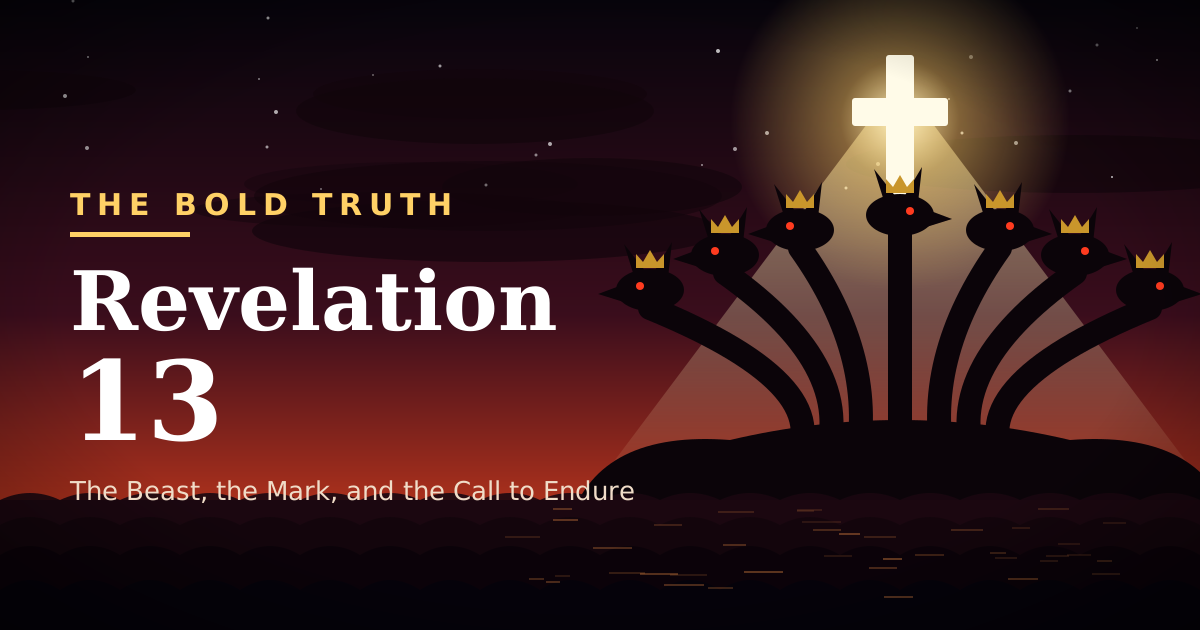
John sees a beast rising out of the sea with ten horns, seven heads and ten crowns, with blasphemous names on its heads. It resembles a leopard, with feet like a bear's and a mouth like a lion's.
Where the imagery comes from. These animals echo Daniel 7, where four beasts rise from the sea and represent successive world empires. John merges them into a single monster, a power that gathers up the worst of every godless kingdom. In Scripture, the sea often represents chaos and the nations in turmoil.
What it does.
- The dragon gives it "his power and his throne and great authority" (13:2).
- One of its heads seems to have a fatal wound that is healed, so that "the whole earth marveled as they followed the beast" (13:3). This is a counterfeit of Christ's death and resurrection.
- It is worshiped along with the dragon: "Who is like the beast, and who can fight against it?" (13:4). This is a mockery of the praise given to God elsewhere in Scripture.
- It speaks "haughty and blasphemous words" and is allowed to exercise authority for forty-two months (13:5), the same period as three and a half years.
- It makes war on the saints and conquers them, with authority over "every tribe and people and language and nation" (13:7).
A call to endurance. Verses 9 and 10 pause with a warning: "If anyone has an ear, let him hear." Then comes the point of the whole passage: "Here is a call for the endurance and faith of the saints." The beast is permitted to rage, but only for a limited time and only because God allows it.
The Beast from the Earth (Revelation 13:11-18)
A second beast appears, this one from the earth. It has two horns like a lamb but speaks like a dragon. That description is itself a warning. It looks gentle and religious, but its voice is the dragon's.
What it does.
- It exercises the authority of the first beast and makes the earth and its inhabitants worship the first beast (13:12).
- It performs great signs, even making fire come down from heaven in front of people (13:13).
- It deceives the inhabitants of the earth and directs them to make an image of the first beast (13:14).
- It is given power to give breath to the image so that it can speak, and it threatens death to those who will not worship it (13:15).
- It forces everyone to receive a mark on the right hand or forehead, "so that no one can buy or sell unless he has the mark" (13:16-17).
Later in Revelation this second beast is called "the false prophet" (16:13; 19:20). Its role is propaganda and religious deception, using miracles and economic pressure to drive people to worship the first beast.
The Number 666 (Revelation 13:18)
"This calls for wisdom: let the one who has understanding calculate the number of the beast, for it is the number of a man, and his number is 666."
The verse tells us two things. First, the number is connected to a human being, "the number of a man." Second, it takes wisdom to understand it. In the ancient world, letters doubled as numbers, so names could be turned into numerical values. Many scholars have noted that 666 can be produced from the Hebrew spelling of "Nero Caesar," and some early manuscripts read 616, which matches a variant spelling of the same name.
Symbolically, six falls one short of seven, the number of completeness and perfection in Scripture. Repeating it three times may picture a human system that always aims at being divine and always falls short.
Throughout history, 666 has been pinned on many people, and every one of those guesses has so far proved wrong or at least unprovable. That should make us humble about anyone who claims to have cracked the code with certainty.
What Is the Mark of the Beast?
The mark on the right hand or forehead is a deliberate contrast with the seal of God on the foreheads of his servants (7:3; 14:1). One group belongs to the Lamb, and the other group belongs to the beast. Hand and forehead also recall Deuteronomy 6:8, where God's people were told to bind his words on their hands and foreheads, which suggests that the mark means allegiance in what we do and what we think.
The mark is not something a believer can accidentally pick up. Revelation 14:9-11 describes it in connection with knowingly worshiping the beast and its image, which is a deliberate choice of allegiance. Be wary of fear-based claims that a vaccine, a bar code, a credit card or a particular technology is the mark. The text speaks of worship and loyalty, and Scripture warns us again and again against being led by speculation (1 Timothy 1:4).
Four Ways Christians Have Read Revelation 13
Faithful, Bible-believing Christians hold different views on how this chapter applies. It helps to know the main approaches.
- Preterist. Most of the prophecy was fulfilled in the first century. The first beast is the Roman Empire and its emperors, especially Nero or Domitian, and the second beast is the imperial priesthood that promoted emperor worship.
- Historicist. Revelation outlines the sweep of church history. Many Reformers, for instance, identified the beast with the papacy, a view that has largely faded among evangelicals today.
- Futurist. The chapter describes a final world ruler, often called the Antichrist, and a coming global religious and economic system in the end times.
- Idealist (or symbolic). The beasts represent recurring patterns in every age, namely oppressive political power and deceptive religion and culture working together against God's people.
Many thoughtful Christians combine elements of these views. For example, they see the beast as pictured first in Rome, as foreshadowing a final Antichrist, and as showing up in every age in which governments demand what belongs to God alone. On the details, we need humility and charity toward fellow believers.
Lessons for Believers Today
1. Satan imitates but cannot create. The beast has a fatal wound that is healed, a worshiped throne and a prophet who works signs, but all of it is a copy. Truth has a counterfeit, which is why we have to know the real thing well.
2. Be careful with power and worship. Whenever any government, movement or leader demands the loyalty that belongs only to Christ, Christians must say no. Daniel's friends refused the golden image, and the early church refused to say "Caesar is Lord." Jesus alone is Lord.
3. Beware of religious deception. The second beast looks like a lamb. Miracles, charisma and religious language do not prove that something is from God (Matthew 7:15; 2 Thessalonians 2:9-10).
4. Endure. The key to the chapter is 13:10: "Here is a call for the endurance and faith of the saints." We are not told to calculate the date of the end or to panic. We are told to stay faithful.
5. Remember who holds the book. The chapter notes that those who worship the beast are the ones whose names have not been written "before the foundation of the world in the book of life of the Lamb who was slain" (13:8). The beast's authority is borrowed and limited, and the Lamb's victory is certain. The very next chapter shows the Lamb standing on Mount Zion with his people (14:1).
How Can I Be Sure I Belong to Christ?
If you are worried about the mark of the beast, the answer in Scripture is not a checklist of technologies to avoid. It is to belong to Jesus. Those who trust in Christ are sealed with the Holy Spirit (Ephesians 1:13-14), and Jesus said of his sheep, "no one will snatch them out of my hand" (John 10:28). If you have repented of your sin and put your faith in Jesus Christ as your Savior and Lord, you do not need to live in fear of Revelation 13. You need to keep following him.
Final Thoughts
Revelation 13 is not meant to frighten believers into hiding. It is meant to prepare them. It tells us honestly that evil can look powerful, persuasive and even religious, and that it will sometimes appear to win. But it also tells us that the beast's time is limited, its power is borrowed and its end is sure. "Here is a call for the endurance and faith of the saints." Stand firm, hold fast to Christ and read the whole book, because it ends with victory: "Behold, I am coming soon" (Revelation 22:12).
What questions do you have about Revelation 13? Leave a comment below, and let's search the Scriptures together.